
CS 101: What are the risks of Community Solar?
Overview: Community Solar is a relatively low-risk way to reduce energy costs, but consistent savings depend on navigating state-specific regulations and carefully sizing your subscription based on your electricity spend. Turquoise Trail Energy Solutions helps manage these risks and guide your business toward reliable savings.
Community Solar partnerships are usually low-risk for subscribers, especially with the common Fixed % Discount or Fixed $/kWh structures discussed in the “What are the Common payment structures?” review. These plans give predictable savings, but before the credits start flowing, participants need to decide how many panels to sign up for. In this step, businesses have to thread the needle between maximizing savings and going too big and paying out of pocket.
The #1 risk of Community Solar: Oversized subscriptions
Before reviewing how to size a community solar partnership correctly, it can be helpful to recap the impact if an opportunity is sized incorrectly.
Community solar partnerships generate bill credits, which can be used against your electric bill to reduce your costs. But what happens if you sign up for too much solar and get too many credits?
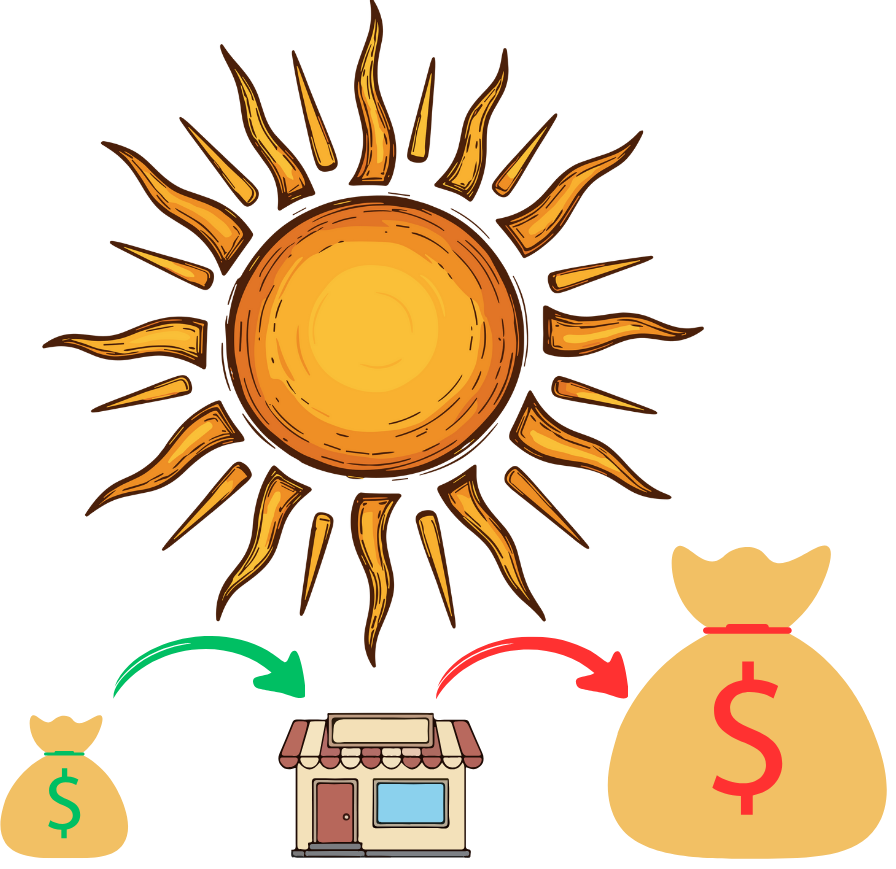
Example:
If a facility has $10,000 in yearly electricity costs but signs up for a partnership that generates $15,000 in bill credits, only $10,000 can actually be used. The critical issue however is that the remaining $5,000 still counts toward payment back to the solar farm owner. With a fixed 10% discount, the facility then ends up paying $13,500 for $10,000 of value.
Different states have rules about what part of the bills community solar credits can be applied against, and solar production can change from place to place. This makes picking the right amount of solar tricky. So, how do you decide?
Sizing the Opportunity Optimally
Maximizing savings while minimizing risk sounds simple but doing it with confidence can be tricky without the right guidance. This is where Turquoise Trail Energy Solutions comes in. Our expertise ensures your business signs up for the perfect amount of solar to unlock the most benefits with the least hassle.
To get the most from community solar without ending up with unused credits, start by collecting 12 months of electric bills for each facility. From there, we’ll need to exclude any charges that can’t be offset with bill credits and make adjustments to capture both changes in long term operations at the facility level, and organizational risk tolerance. The final step involves then reviewing bill credit rates and individual projects to ensure the total financial value sent to your facilities doesn’t exceed the identified eligible electricity spend.
We believe energy savings should be simple
Turquoise Trail Energy Solutions was established to help businesses address rising energy costs and make confident choices on their energy strategy with clarity, transparency, and ease. To learn more, continue with our 5-part Community Solar 101 Series, where you’ll also learn:
Whether you have questions related to community solar, your electric bill, or your savings options in general, we’re here to guide you towards a smarter solution. Reach out to speak with an expert that can help you choose the right path.
